Sunday, July 31, 2011

Outdoor dogs: Oh what that fur coat may be hiding

This is the story about a hot spot.  It's about a hot spot that started off small and grew up big and bad.  But at least this story has a happy ending because they do not all turn out that way.

"Hot Spot" is a fairly common term used mostly to describe a moist area of skin infection and most of the time we use the term when we are talking about this skin lesion on dogs.  If you haven't heard the phrase "hot spot" before, here is a nice article "Hot Spots in Dogs: What are they? How to cool them down!" that talks all about them.  Veterinarians see hot spots all year-round but they are certainly more common in the summer because the underlying causes (fleas, insect bites, scratches from thorns, allergies, etc.) are more common in summer.  But the "hot" in hot spot is not because we see them in hot weather, it is because the skin is "hot" and inflamed.  And while most hot spots are indeed a "spot" on the skin, as you will see from this next case, they can become very large and do so very quickly.

Except in some cases of working breeds of dogs (Alaskan Huskies come to mind and sheep/cattle guarding dogs as another), I never quite understand why someone would have a pet dog and leave them tied outside 24/7.   But I have seen it work well many times for both dog and owner so I am not judgemental as to say it should never be done. (There are those who would criticize me for all my outdoor barn cats too.)  However, if you have an outside dog, there are some particular hazards that you need to watch such as heat related issues in the summer and cold related issues in the winter.  And in the summertime, you need to pay particular attention to the health of your dog's coat and SKIN!  That is SKIN capitalized with an exclamation point!  Most of our dogs are very very furry and that fur can hide a lot of problems. 

This is a picture of Big Red (not his real name) the Saint Bernard.  He is sedated and lying on a treatment room table.  Red came to the clinic because his owner had been trying to clear up a skin infection for about a week and things were getting worse and getting worse quickly.  I fully believe that all of this happened in about a week because I know how fast a small hot spot can turn into a big hot spot.
Doesn't look too bad does it?  You can tell the fur is a little matted up along his back, but most of this is because the owner had been using Kopertox to try and treat the skin infection.  For those who don't know, Kopertox is a green liquid that is used to treat a condition called "Thrush" that occurs on the bottom of hooves in horses and cows.

Now here is a little side note and a heads up for all dog owners.  If you want to make your veterinarian or veterinary technician thoroughly disgusted and upset with you, go ahead and treat your dog's wounds with anything sticky or gooey.  This means BAG BALM or VASELINE or CORONA OINTMENT or KOPERTOX or the list goes on and on and on.  Gooey ointments are not meant for animals with thick fur coats and all they do is make everything worse.  They attract dirt and they keep wounds moist when wounds really need to dry out.  They gum up clipper blades when fur is needed to be shaved from a skin wound and makes the job 300% harder.  Enough said.

Now back to Big Red.  Big Red was an outside dog.  He had a hot spot start on his back.  He lived outside.  It is summertime.  Can you think of what might make this whole situation worse?  I'll give you a minute to think.  Times up.  Think flies.  Think maggots.  To give Red's owner credit, he was trying to work on this problem.  He had been hosing Red off with water every day.  He saw that every time he hosed the dog, maggots would be flushed out of the wound area.  He tried fly spray, but the hot spot had already started to spread and was like a runaway train.  Other than the Kopertox (which I think was just applied in a moment of frustration), the owner was doing everything right, but he did not know the first basic principle of treating a hot spot.  You HAVE to shave the fur off the infected area of skin.  Oh, you can sometimes get by without this step in an inside dog with a half dollar or small sized hot spot.  But if you have a big dog with a wound and it lives outside and it is summertime, you HAVE to shave the fur.  And so that is what we did and this is a picture of Red after having his hot spot shaved.


And then one more picture after his skin has been cleaned and scrubbed and he is sleeping on the big blue furry blanket in the clinic kennel area.


This looks awful and it is, but this is not a case of abuse.  This is just ignorance.  Ignorance can be cured through education.  And thus the purpose of this blog.  Red's story has a happy ending.  His owner brought him in early enough that Red walked into the clinic with a wagging tail and left with a wagging tail.  Not all maggot infested dogs are as lucky.  I've seen many that have to be carried into the clinic on a stretcher.  Some live, but some get to go home in a body bag.

And so the lesson to be learned from this little adventure is if you have a dog and especially an outdoor dog, you need to be DAILY checking your dog over for what might be hiding under that fur coat.  Your dog's life could depend on it.

Saturday, July 9, 2011

Paying for veterinary care

Well, well, well, it has been some time since I have blogged.  My only excuse is life being busy.  Not only is May, June and July the busiest season for veterinarians, it is also busy farming season and I have responsibilities on the farm too.  Keeps me out of trouble, but also keeps me off the computer.  Which is probably a good thing in a way. The best part is I have a few blog topics lined up ready to go.  One is a REALLY happy story that I want to share and I also have a sad and hopefully thought provoking story to share.

One of the very self indulgent parts about blogging is that along with passing on (hopefully) useful information, I get to clear my head of junk that is building up inside.  One of my staff said I was getting feisty today.  I think that is an accurate assessment.  99% of my clients are beautiful people.  I am blessed to spend my days with such wonderful people.  We laugh together, we cry together and we enjoy life with our pets together.  But there is that 1% that makes you wonder and when you get a few one percenters stacked up back to back in a few days, it can drive a person to become feisty.  Like the person who brought their VERY healthy looking overweight cat to me to be put to sleep.  When I asked why, they said the cat has a tendency to throw up and they were getting new carpeting and didn't want to deal with the mess.  Really? (I did not do the euthanasia by the way.)  Or was it the person who brought their sick dog into the clinic and when I asked them how long it had been since the dog had not been eating normally, they told me 6 months.  Really?  Or was it the guy in the exam room who was upset about the estimate I gave him and became very irate with me and said "Look here girlie"?  Really?  You are really calling me "girlie"?  Come to think of it, maybe I should have taken that as a compliment.  I was at least about as old as he was and probably older.  I feel much younger now.  Thank goodness for the ninety-nine percenters.  I love you all and you keep me sane.

And so I am going to re-start my blog with a topic that always seems to get those feisty feelings going:  Why most veterinarians will not bill clients for veterinary care, but instead ask for payment at the time of service?  And then my goal is to put a positive spin on the topic and list some suggestions for pet owners so they can be prepared financially in case of a pet health emergency.  And because I really like reading blogs that have pictures attached and because I do not have any pictures lined up for this topic, I am going to randomly insert pictures of my chickens.

Mama Chicken.  One of four hens that have been elevated to "pet" status on the farm.  She is a barred Plymouth Rock.  My oldest chicken.  I think she is around 5 or 6 years old now.


Give this some thought.  If people you barely know came up to you on a daily basis looking for a loan and told you "My family won't loan me any money.  My friends won't lend me any money.  The bank won't lend me any money.  But I really think you should lend me money because I need some."  How would you feel about that?  Would you lend them money?  Maybe you would lend money to the first few people who asked because you are kind hearted and feel bad for that person's plight.  How would you feel if at least 90% of these people never paid you back?  What if you were lending so much money to people that now you yourself were not able to pay your bills?   I guarantee that after weeks, months, years of this, you would feel taken advantage of and you would not want to lend money to strangers any more.  This is the scenario that plays out in every veterinary clinic multiple times every day.  People who we barely know are asking us for money.  I'm sorry, but if friends, family and banks won't lend you money, that is a red flag as to your reliability in repaying your loan back to the clinic.

This is Whitey.  Also a pet hen, she is a Delaware.  Whitey is my most social chicken and follows me around a lot when I am working around the barns.


So we have a dilemma.  Someone calls or shows up with a very sick pet needing medical care and they have no money to pay for treatment.  They are distraught because they love their pet and don't want it to die.  On the other side we have the veterinarian.  He or she loves animals (yes, we all do.  It is why we got into this business.)  We do not want to see animals die either.  But we have a business to run.  If we do not make money, our business ceases to exist.  We employ people who need money to live.  They have their own families to take care.  If the veterinary practice where they work ceases to exist, they lose their means of supporting their family.  This is an emotionally charged issue on both sides.

So I bring you a real life story to make a case for the veterinarian's side of this issue.  After 20+ years of being a veterinarian, I am pretty adamant about not allowing people to run up a large balance for veterinary care at the clinic where I work.  But because I do love animals, there is this soft hearted side of me that creeps into the picture about once a year.  I always seem to get burned, but that is the name of the game.  About 6 months ago, a woman who had never been to the clinic before brings in a sick dog.  The dog is VERY sick and will die without treatment.  The disease is bad and the treatment is complex and time consuming and therefore expensive, but there is a VERY good chance that with treatment the dog will live.  I start talking to the woman about how she is going to pay for the treatment.  She does have some money, but not nearly enough to cover the entire cost.  She is crying.  I feel bad.  We try to get her approved for our clinic's third party payment program.  She is declined.  She cries.  I feel bad.  I know I can save this dog's life.  I explain that I cannot let people I don't know charge for services because there is a tendency to not pay.  She looks me straight in my eyes and tells me that she is not like those other people.  She is different.  She will pay her bill.  She sounds so damn sincere.  She cries.  I feel bad.  I give in.  I get my staff to reschedule all my afternoon appointments so that I can perform emergency surgery on this woman's dog.  I am now relying on this woman's word to pay my staff for that day, pay the electric bill for that day, pay the rent for that day, pay for the drugs I used on her dog, and many many other bills that need to be paid to run a veterinary practice.

A box of day old Golden Buff laying pullets arrives at the farm.  There are few things cuter that day old baby chickens.


So what happened?  The dog is alive and doing well.  The clinic has received one very small payment since the dog went home and that was about 3-4 months ago.  Nothing since.  This one woman's bill is nearly 10% of our entire accounts receivable balance.  It's ok though.  I have used up my quota of random lending of money this year, but next year is open if you want to come see me then.

So let's take all the negativity out of this topic and let me lay out some positive steps that pet owner's can do in order to have money in a pet health care crisis.

1. If you borrow money from ANYONE, pay it back.  OK, this one might sound kind of flippant, but it really works.  You have a much better chance of borrowing money from someone you know in a crisis than from someone you don't know.  However, if you borrowed $500 from your brother 3 years ago and never paid him back, he is probably not going to want to lend you more money now.  Common sense, eh?

2. This is a corollary to #1.  Establish a relationship with a local veterinarian.  Take your pet in for regular check ups.  Even if you cannot afford to do every preventive medical recommendation your veterinarian gives you, at least do something.  And do it every year.  This is just human nature, but I am much more apt to lend money to someone I know.  Most veterinarians are the same way.  We want to know that people are at least putting some effort into caring for their pets.  And if you can't afford to spend at least $100 per pet per year on a veterinary visit, perhaps you should not have a pet.  (I think a good blog topic would be how can people who love animals, but who have very little money, still have animals as part of their lives.  I have some ideas on that one.)

3. Get a credit card.  If you do not like credit cards because you have no self control and spend beyond your means, then get one anyway.  Give it to your meanest family member and have them hold on to it and only give it to you for emergencies.

4. Start a pet health care savings account.  OK, this one takes some motivation, but it works and is probably the smartest choice financially.  Might want to enlist the help of that mean family to oversee this account too.

5. Ask your vet about third party payment programs.  Most vets use them.  Get approved ahead of time.  If you are declined, find out why and fix it.

6. Pet health insurance.  This business is in its infancy, but it may be a good option for some.  It forces you to put money aside for your pet's health care and can often cover a higher dollar amount than some people can save on their own.  Most veterinarians will give you pointers if you want to go this route.  Ask.

7.  Lots of communities have programs to help senior citizens and those on fixed incomes pay bills.  Our county senior center has set up a program with donations from the local kennel club that helps seniors pay veterinary bills in case of a treatable illness.  Ask around your community BEFORE the crisis happens to see what programs are available.

8.  Look online.  There are many organizations from veterinary associations to humane societies that have money earmarked to help people with veterinary bills. 

So there are my 8 ideas, anyone else have any good ones?

Thursday, April 21, 2011

Chicken feet and the call of the wild

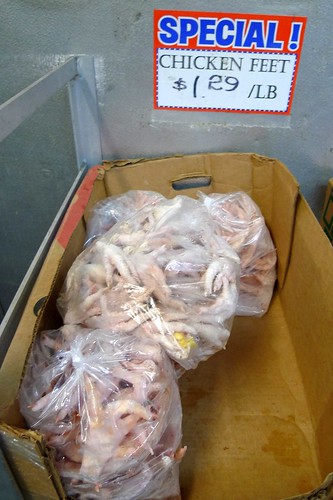
I dedicate this blog to the big healthy portion of chicken feet pictured above and those who love to eat them.


Food and food choices absolutely fascinate me.  The science of nutrition fascinates me.  Perhaps that is why my college days (before vet school) were spent pursuing a degree in animal nutrition.  Animal nutrition was going to be my fall-back profession just in case I did not get into vet school.  Now that I am focused on medicine, my nutrition interests have become more a personal hobby, i.e. cooking for me and my husband.  Of course it helps that we live on a working vegetable farm and have an endless supply of fresh veggies all summer long.  And we raise our own chickens both for meat and eggs.  I do a lot of home grown food preservation so we can enjoy summer's bounty all year round.  I have come to truly appreciate the labor and the taste of cooking from scratch.  Not to say that I don't have some processed food items in the pantry for those weeks when late nights at the clinic use up my supply of pre-made homemade meals.  Sometimes when the body is tired from a long day at work, nutrition becomes more of a necessity rather than something to be savored and enjoyed.  Give me a microwavable dinner and let me go to bed!


Because I enjoy preparing meals so much, I get the whole homemade pet diet craze.  I don't partake it in personally, but I get it.  While I prefer sitting down to a meal with roast chicken from my farm, homemade mashed potatoes and steamed broccoli from the garden over chicken nuggets and previously frozen french fries, my dogs do not show the same type of preferences in their diet.  They are what I call "appetite driven" and not taste driven.  They show the same enthusiasm toward a bowl of dry commercial dog food kibble as they do a few morsels of my cooked chicken as they do the mouse that one of the barn cats left in the back yard three days earlier.   OK, that last one is a fairly bad example because it is quite rare that the rodent carcasses brought home by the cats last more than a few seconds if discovered by any one of the dogs.  But you get my point.  So while I do home cook for myself, I admit I take the easy way out and feed commercially prepared food to my dogs and cats and chickens for that matter.  Lots of science goes into creating balanced and nutritional diets for animals and I am more than happy to take advantage of all the hard work spent to create a balanced animal food.  Scooping feed out of a bag simplifies my life enormously and I've always had a healthy bunch of animals in my household and on my farm.


As a veterinarian, I have very little problem with most commercial diets.  I see dogs that are healthy eating every type of dog food from typical grocery store fare to exotic pet shop diets.  For that reason, I am very hesitant to recommend specific brands when having discussions about what to feed pets (unless there is a medical need).  I think the obesity problem (that means OVER feeding) has way more to do with how healthy or unhealthy our pets are than what brand of food they eat.  Genetics plays a HUGE role too.  There was an interesting study published in the Journal of Veterinary Internal Medicine recently about causes of death in dogs by breed and age.  Not surprising was that as dogs grow older they are more likely to die from cancer.  Some would blame our environment or diet as the culprit, but interestingly enough was that after a certain age, the incidence of cancer started going down.  You would expect that if diet or environment were totally to blame that the cancer incidence would continue to climb all the way through the oldest individuals.  It doesn't .  Here is a nice blog that discusses this study.


But you would be living under the proverbial rock, if you did not at least know there are murmurings about how bad commercial diets for our pets.  Ah yes, the internet buzz.  I have three issues with the undeserved demonization of commercial pet diets.  The same people who have jumped on the "raw diet" and homemade diet bandwagon are the same ones who proclaim commercial pet foods are some toxic product of the animal slaughter house industry because you will find ingredients such as chicken by-product meal in pet food.  Oh the horror when it is discovered that chicken by-product meal is this: " Chicken by-product meal consists of the ground, rendered, clean parts of the carcass of slaughtered chicken, such as necks, feet, undeveloped eggs and intestines, exclusive of feathers, except in such amounts as might occur unavoidable in good processing practice.".  Chicken feet!  Oh my, it contains chicken feet!  Well did you know that chicken feet actually do have some nutritional value?  They are considered a delicacy in many Asian cultures and can be found pre-packaged on grocery store shelves in many parts of the world.  Just because most Americans (me included) wouldn't put a chicken foot within a few feet of my mouth doesn't mean they aren't edible.  Actually one of the women who was at one of our farm's chicken butchering days last year requested cleaning and packing up some of the chicken feet because her mom makes soup stock from them.  No problem.  I was planning on throwing them out.


But yet the "raw food" crowd jumps up and down and shouts how raw diets are "natural" when all they are feeding is meat and perhaps ground up bones and veggies.  What is so wrong with the feet, necks and internal organs and perhaps a few feathers mixed in?  The coyotes that raid the farmer's chicken coop don't seem to mind eating those other parts along with the meat and bones.  I don't get the prejudice against animal parts that most AMERICANS do not tend to eat.  And what is great about chicken by-product meal is that it is cooked so that all the nasty bacteria and parasites that are found in raw food are now dead.


The second issue I have with raw food diets is the "raw" part.  I've gotten a little better with my own cooking, but after going through public health class in vet school and learning about all the parasites that occur naturally in the meats that we eat, I had a tendency to cook every cut of meat until it resembled a charcoal briquette.  Not because I wasn't paying attention to how long I cooked my meat.  No, it was quite purposeful as I would flip burgers on the grill and mutter "die parasites die" under my breath.  I have loosened up a bit these days in the pursuit of good flavor and juiciness of the meat I eat, but you will never catch me eating Sushi.


Raw foods can be an issue for pets too.  Remember about how my dogs love to snack on the rodents that the barn cats catch and deposit so lovingly on the front porch of the house?  Well this caused quite a bit of embarrassment for me last winter.  I used to let the dogs sleep with me in bed before I got married.  Then I married a farm boy who was raised with the "dogs don't belong in the house" philosophy.  He was quite tolerant of the dogs in the bed until one day one of the dogs ate a pile of cat poop outside and then proceeded to jump on the bed and vomit said pile of cat poop all over said bed.  That was the last day the dogs were allowed on the bed.  He has no problems with the dogs in the house (and even cuddles with them on the floor every day), but no dogs in bed.  Because I don't sleep with the dogs anymore, I may be a little slower on the uptake about things like, um, tapeworms (which dogs get from eating rodents).  Sue, our office manager, was so kind to watch my old dog Molly at her house while my husband and I went out of town on vacation.  Sue has such a kind heart and even though Molly is not allowed on the furniture at my house, Sue puts a blanket on her couch and lets Molly sleep there.  When I got back from vacation Sue informed me that she had found tapeworm segments on her couch.  Ooops!  So sorry Sue.  Guess I had better worm my rodent eating dog.   Dogs and cats DO get parasites from raw food.  They DO get salmonella and other bacteria from food.  As someone who sees firsthand the harm that parasites and bacteria can cause pets and people, I don't understand why cooking pet food is evil to the raw food believers.  I guess I can't understand everything.  I will continue to cook my food and mutter "die parasites die".  I am a cooked food believer.


Last but not least is the nutritional balancing act.  You've got your big nutrients (carbs, proteins and fats) and your little nutrients (vitamins and minerals).  All must be in balance.  Now there is some deep philosophical stuff right there.  So for those who want to make homemade diets for your pets,  I beg you PLEASE learn how to do it correctly.  It takes months and months of eating a diet with nutritional deficiencies before you might see a problem.  It makes me so sad to see a blind cat or a young dog with thin brittle broken bones all because they were eating a poorly made diet.

I am going to give you two great sources of homemade diets.  Both companies are run by veterinarians.  Both are VERY reasonably priced for their consultation services.  One is BalanceIT and the other is PetDiets.com.  Check them out so I don't have to see your pets in my office for a nutritional deficiency.  I have enough to do treating all the bone impactions and the diarrhea from people feeding raw diets to their pets. (OK sorry I couldn't resist that.)

As for me, I will be heading home to make some homemade enchiladas with rice and beans for me and my husband and scooping food out of a bag for my doggies.  Guaranteed smiles from my husband and wagging tails from the wooferdoodles (as I like to call them).

Thanks again to Flickr creative commons for some of the photos (linked back).